Friday, March 9, 2012

Norien's Surface Area and Volume Post

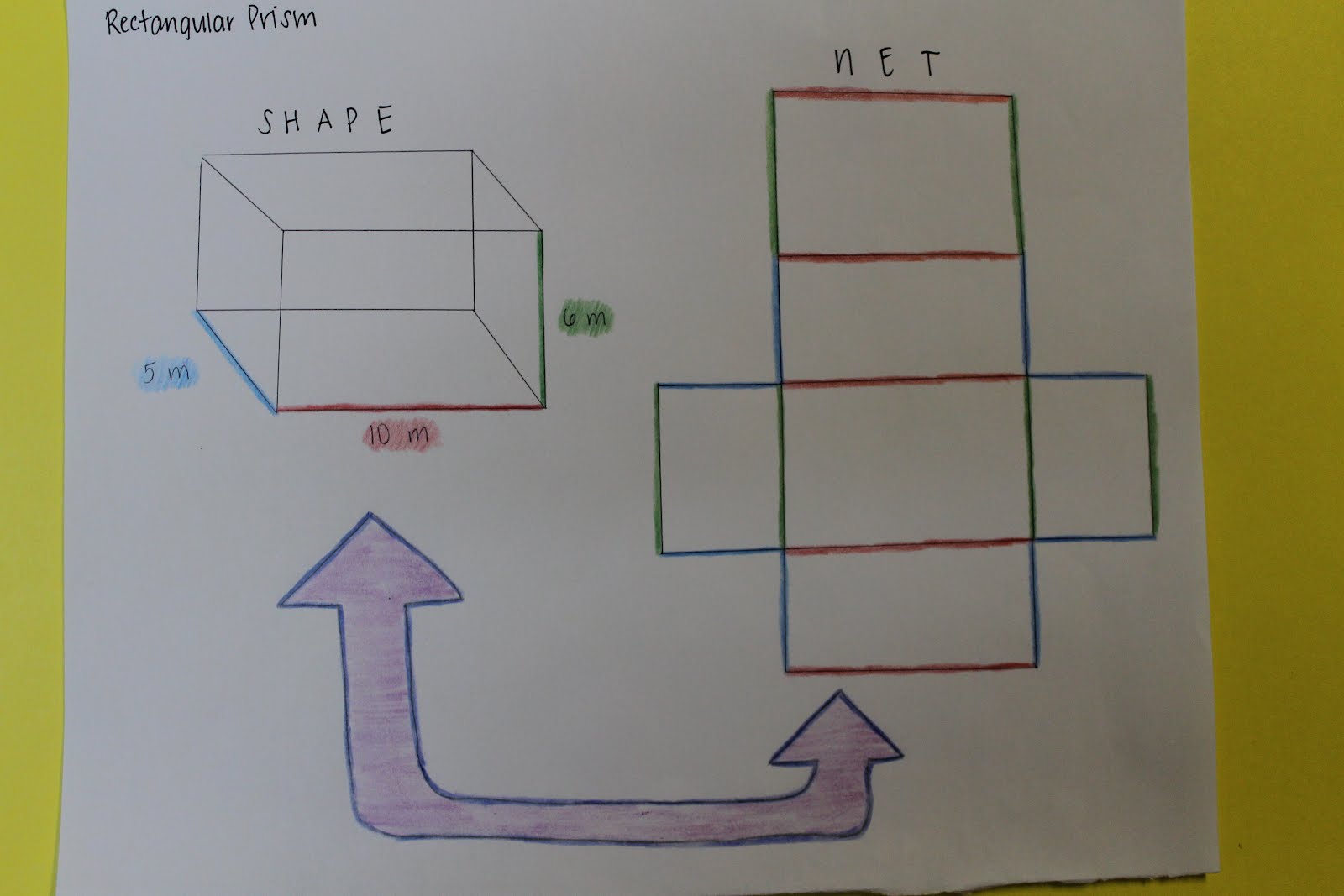
Rectangular Prism
Shape/ Net:

Solution:
To find the total surface area (TSA) of a rectangular prism, the first step is to find the areas of the six faces of a rectangular prism. To find the areas, you have to find the lxw of the top, front, and side to get the area of one face. 5x10= 50 m2 (Top), 6x10= 60m2 (Front), and 6x5= 30m2 . Once you have the lxw of the top, front, and side of the faces, you add it all up and get 140. With the 140 you multiply it by two to get all six faces of the rectangular prism and the answer to the total surface area would be 280 m 2

lxw
5x10 = 50 m 2
6x10 = 60 m 2
6 x 5 = 30 m 2

TSA = 2(T+F+S)
= 2(50+60+30)
= 2(140)
= 280 m 2


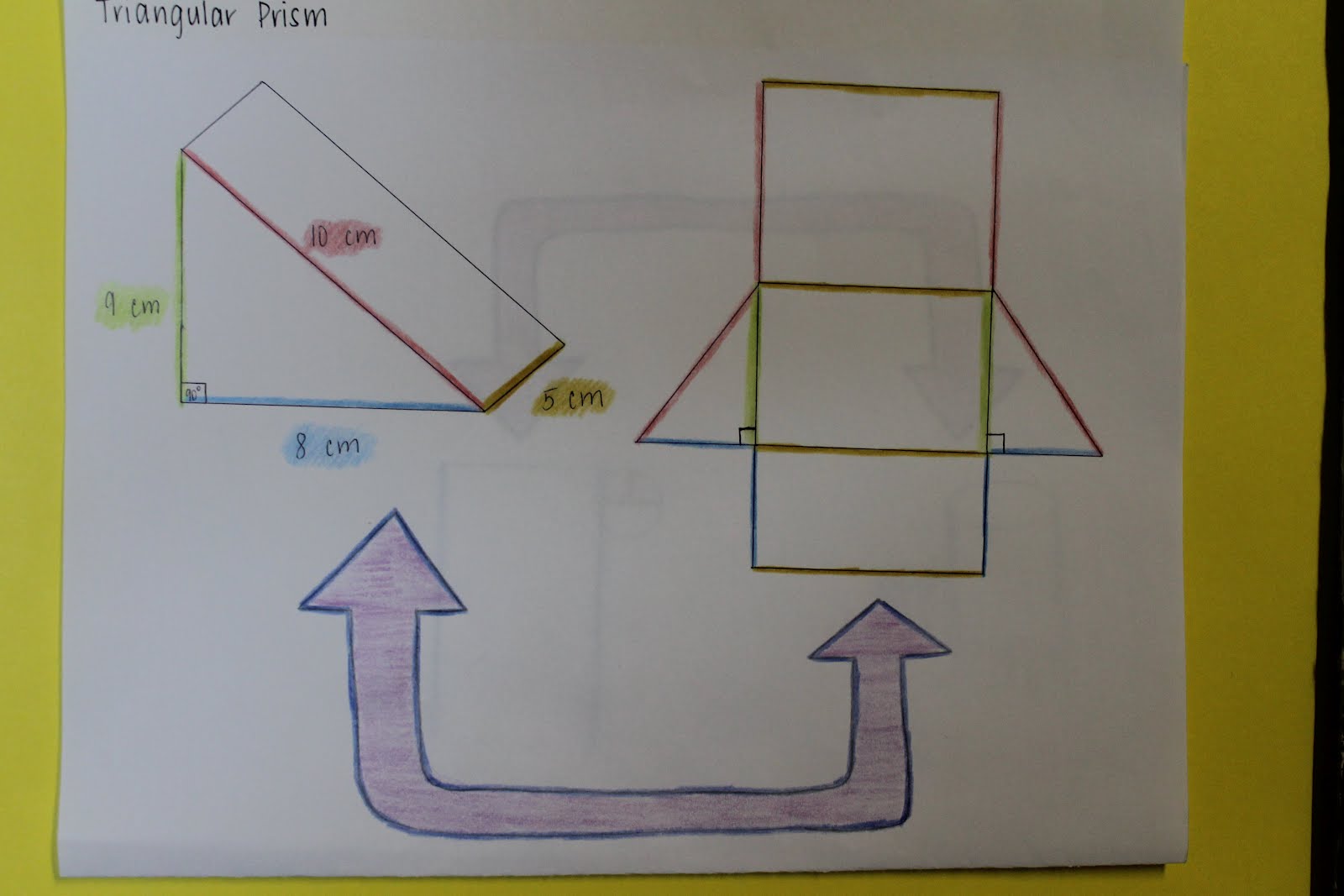
Triangular Prism
Shape/ Net:
Solution:
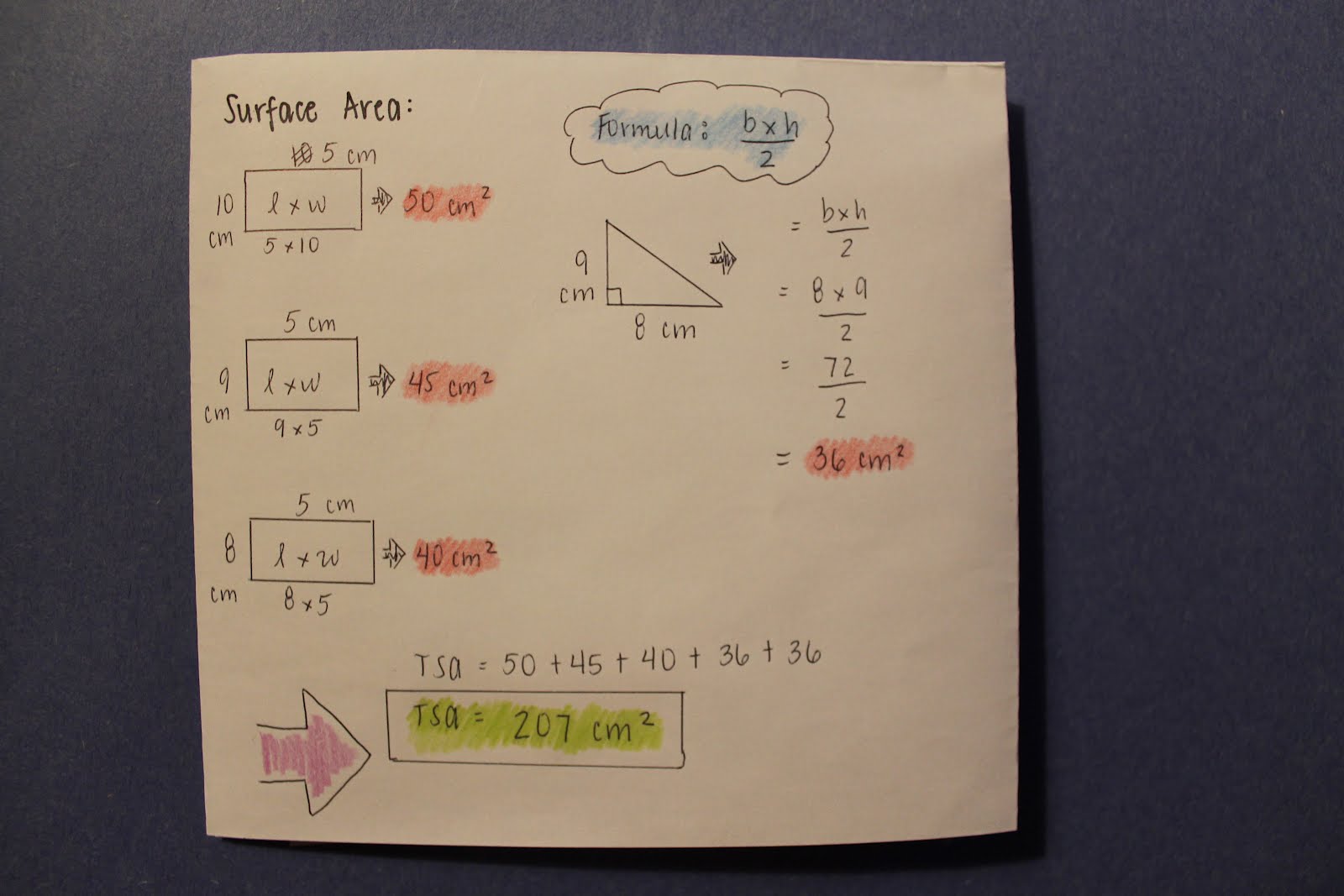
To find the total surface area (TSA) of a triangular prism, the first step is to find the areas of the three faces of the rectangles in a triangular prism. You have to multiply the length and width. To find the length you have two choices, you can either multiply it one by one like, 10x5, 9x5, and 8x5 or you can add the 10cm, 9cm, and 8cm and multiply it by the width which would both equal to 135cm 2 . After finding the area of the rectangle faces, you have to find the triangle faces. To find the rectangular faces, you have to use the formula, which is to multiply the base by the height and divide it by two. 8x9 = 72, 72/2 = 36 cm2 . After you find all those areas you add them all together (NOTE: Don't forget to add another 36 because there are 2 triangles in a triangular prism), the answer would be 207cm 2

lxw
= 27x5
= 135 cm 2
= 36 cm 2
= 36 cm 2
-----------
207cm 2
bxh
--------
2

8x9
--------
2
72
------
2
= 36 cm 2

Cylinder
Shape/ Net:
Solution:
To find the total surface area (TSA) of a cylinder, the first step is to find the radius if they give you the diameter, or find the diameter if they give you the radius because you will need both.
In this cylinder they gave us the diameter which means we will need to find the radius and to find that we need to divide the diameter in to two, which would mean we would have to divide 8 by 2 and get 4mm. The next step would be to find the circumference of the rectangle. To find that you will need to use the formula which is c= π d, c= 3.14x8, c= 25.12mm. Next you will multiply the length times the width of the rectangle. The length would be 25.12 and the width be 12 and when you multiply those two together the answer would be 301.44mm 2 . Next, you will find the area of the circle and to do that you use the formula; a= π r, a= 3.14x4, a= 3.14x16, a= 50.24mm 2 . Lastly, you have to add the area of the rectangle (301.44) and the two circles (50.24) together which would get you, 401.92mm 2


If you did not understand my explanation or need more examples, here is a link.

Volume

Volume of Rectangular Prism
To find the volume of a rectangular prism, you have to multiply the length, width, and height together. Remember: It doesn't matter which one you multiply first because technically they will all equal to the same number, no matter the order.
v= l x w x h
v= 16 x 20 x 8
v= 2560 cm 3

Triangular Prism
To find the volume of a triangular prism, you have to multiply the base and height and divide it by 2, to get the area of the triangle. Then you have to multiply the second height (non- triangle number) by the answer to the area of the triangle.
v= (b x h1 / 2) x h2
v= (3 x 5 / 2) x 8.5
v= (15 / 2) x 8.5
v= 7.5 x 8.5
v= 63.75 m 3

Cylinder
To find the volume of a cylinder, you have to use the formula, π r 2h. First, you have to find the radius by dividing the diameter by 2. Then you have to square the radius and then multiply the 3.14 by the answer you got
for the radius and then multiply it by the height of the cylinder.
r= d/2
r= 12/2
r= 6cm

v= π r 2h
v= 3.14 x 6 2 x 15
v= 3.14 x 36 x 15
v= 1695.6 cm 3

How To Get the Volume of a Fraction of a Triangular Prism
To get the volume of a triangular prism is already on my post (second one). But What isn't on mine is how to get a fraction of a triangular prism. First you have to divide the numerator by the denominator and the decimal you get from that, you have to multiply it by the answer you got from the triangular prism volume.
v= (bxh1/ 2) x h2
v= (4x8/ 2) x 6.5
v= (16/ 2) x 6.5
v= 8 x 6.5
v= 52cm 3

fraction : 3/ 8 = 0.375
0.375 x 52 = 19.5 cm 3


Kyanna's Surface Area Post

1) Rectangular Prism 280 m2


Solution: Top = LxW 10m
x 5m= 50m
Front= LxW 6m x 1om= 60m
Side= LxW 6m x 5m = 30m

Total Surface Area: (TSA)

To find the (TSA) you have times length x width of each side , then add it up all together times 2. Ex:
TSA=2(T+F+S)

TSA= 2( T+F+S)

TSA= 2( 50 + 60 + 30)
TSA= 2(140)

TSA= 280m2


2) Triangular Prism 207 cm2


Solution:
LxW= 9x5 = 45cm
LxW= 8x5= 40cm
LxW = 10x5= 50cm

Because there is two triangle's there will be two 36 in the solution

TSA= 135+36+36= 207cm2


3) Cylinder 401.92 mm2


Solution:
R= d/2 C=pi d
R=8/2 C= 3.14 x 8
R=4mm C= 25.12 mm


A= pi r2 L x W
A=3.14 x 4 x 4 12 x 25.12 12 x 25.12
A= 50.24mm 301.44mm


Because there is two circle there will be two 50.24 is the solution


TSA= 301.44 + 50.24 + 50.24 = 401.92 mm2


PLEASE COMMENT IF THERE IS SOMETHING WRONG :)


v= pi r r h
v= 3.14 x 5 x 5 x 8
v= 628 cm3

4/5 full
4/5= 0.8
v= 0.8 x 628
v= 502.4 cm3


v= LxWxh
v= 12 x 4 x 7
v= 336 cm3

3/4 full
3/4= 0.75
v= 0.75 x 336
v= 252 cm3


Joy's Surface Area And Volume Post

Rectangular Prism:

Shape Net:

Calculate Surface Area:

Total Surface Area:
=2 ( T+F+S)
=2 ( 50+60+30)
=2 (140 m2 )
= 280 m2
Triangle Prism
Shape Net:
Calculate Surface Area:

Total Surface Area:
= T+F+S
= 135+ 36+ 36
= 207m2
Cylinder:
Shape Net:
Calculate Surface Area:

Total Surface Area:
= Circle+Circle+Lateral Area
= 50.24+50.24+301.44
= 401.92 m2
Volume:


Tinille's Surface Area and Volume Post


What is a Prism:

- A prism is three dimensional geometric shape.

- ends have the same size or shape

What is a Surface Area:

- measures the combined area of all the surfaces of a 3D shape.


  • Rectangular Prism

NET:


WORK:


How to get the answer for finding Rectangle's Surface Area:

Step 1: Find the top, front and side length and width of the rectangles.

Step 2: Multiply the length and with of the 3 sides using the formula l x w = area.

Step 3: After finding the area of each sides, you have to use the formula TSA= 2(T+F+S) to find the total area of the rectangular prism.

NOTE: We are multiplying the total of top, front and side because there are 6 pieces in a rectangular prisms. Top and Bottom are the same so as Front/Back and Side/Side.


  • Triangular Prism

NET:


WORK:


How to get the Total Surface Area of a Triangular Prism:

Step 1: Find the 3 rectangles and their lengths and widths.

Step 2: Using the formula l x w= area. Multiply the length and width for each rectangle to get their areas.

Step 3: Then, we have to find the base and height for the 2 identical triangles.

Step 4: Using the formula, bxh/2 (base multiply height divided by 2). Multiply the base and the height. Then after multiplying the base and height. You need to divide it by 2 to get the area of the 2 identical triangles.

Step 5: After finding all the areas of the 5 sides in a triangle. You need to add all of the 5 areas to able to find the Total Surface Area of the triangular prism.


  • Cylinder

NET:


WORK:


Formulas that will help you to be successful in finding the TSA of a cylinder :

: TSA= 2(π x r2 ) + (π x d x h)

: To find the radius: r=d/2 (diameter divided by 2)

: To find the diameter: d= 2r (2 multiply the radius)

: To find the area of the circle: circle= πr 2

: To find the width for the rectangle: circumference= πd

: To find the area of the whole rectangle: l x w = area (length multiply width)


  • Here is a GAME for you to play and practice before the test on March 12.

    I hope I helped you in this scribe post. Also, I hope you'll memorize all the formulas so you can be successful. :D
  • I would greatly appreciate if you comment below on where I could improve on and I did something wrong so I could change it as soon as possible. :)


  • PLAY MANGA HIGH! GOOD LUCK!


-------------------------------------------------------------------------------------------------

Volume of Prisms
What is a volume?
- a meat cutter and it uses spaces for measurement.

  • Triangular Prism


Rectangular Prism


Prism with a FRACTION


Cylinder


To be able to find the VOLUME of a prism, you need to remember all the formulas in order to get the right answer. These are the formulas for each prisms:

Triangular Prism: Rectangular Prism: Cylinder:

v= (bxh1/2) x h 2 v= l x w x h v= (πr 2) x h


NOTE: In addition to that, If you're finding the shaded part of the prism and the fraction is given. Divide the fraction and if its an UGLY decimal, you have to divide the answer to the fraction's denominator and multiply it from the numerator. BUT. If the decimal is NOT ugly, you have to multiply the decimal and the answer to be able to get the right answer fort he shaded part.


Here's a game to help you learn more about finding the volume of a prism. :D

Also, if you want to learn more about volume you should watch this video (below). To be honest, it is quite long but its worth of your time! :D

Sorry for the 2 pictures, I rotated them as many as I can but whenever I tried to add it, it was just not rotated at all. D;

Camille's Surface Area


Solution:
T- TOP
S- SIDE
F- FRONT
Find the Lenth and Width for each one.
Top- 5 (width) 10 (length)
Side- 6 (width) 5 (lenth)
Front- 6 (width) 10 (length)
Then multiply them
5 x 10 = 50
6 x 5 = 30
6 x 10 = 60
After you get the answer, add them together.
50 + 30 + 60 = 140
Then multiply it by 2, you get 280m²
So, your answer is 280m²

Solution:
Find the sides of the Triangle.
First side- 5 (length) 10 (width)
Second side- 5 (length) 9 (width)
Last side- 5 (length) 8 (width)
After you get the Length and Width, add them all up.
10 + 9 + 8 = 27cm
When you get the answer, multiply the answer by the length.
27 x 5 = 135cm²
Now, find the bxh.
9 (height) 8 (base)
B x H * 2 ( * - divide )
9 x 8 = 72
Now, divide 72 by 2.
Answer- 36cm
Take 135cm² and add 36cm twice.
135 + 36 + 36 = 207cm²
207cm² (answer)
Solution:
Find the top circle of the Cylinder and the bottom.
The diameter of the circle is 8. You have to find the Radius, by dividing the diameter by 2.
8 (diameter) * 2 = 4 (radius)
Now, find the body of the Cylinder.
The width of the rectangle (body) is 12mm
Find the circumference by multiply the pi and the diameter.
3.14 x 8
C = 25.12mm
Now, find the area of the rectangle.
Length x Width
25.12 x 12 = 301.44mm²
After that, find the Area of the circle.
Pi x radius²
3.14 x 4²
3.14 x 16
= 50.24mm²
Now, the body (rectangle) and the area of the cirlce, add all them up. But you need to add up the answer from Area of the circle.
301.44 + 50.24 + 50.24
= 401.92mm²
Volumes:
Volume of Triangle
Formula:
Area of base *multiply* height
Find the base and the height
base- 3cm
height- 5cm
Now find the other height. The height is 8.5cm
Multiply the base and the height (bxh) after you get the answer, which 15. Then divide it 2. (15 divided by 2 )The answer is 7.5. Now multiply 7.5 to 8.5cm. Equals to 63.75cm³
Volume of Rectangle
This formula is very easy. Just multiply the Length and the Width and the Height.
20x8x16 = 2560cm³
Volume of Triangle with fraction
Formula:
The formula is the same as the Volume of Triangle.
But if there's a fraction with it, you have to do is, find the decimal of the fraction. (3*8= 0.375cm)
After you get the decimal of the fraction, multiply it by the answer you got (104cm³)
104 x 0.375 = 39cm³
Volume of Cylinder
Formula:
d2 = r
12 * 2 =
6= radius
pi r2 x h
3.14 x 6 x 6 x 15
3.14 x 36 x 15
= 1695.6cm³