Showing posts with label scribepost. Show all posts

Monday, March 12, 2012

Paulo's Surface Area and Volume Post


Surface Area


#1Rectangular Prism


Shape and the Net


Solution- correct if i am wrong


#2Triangular Prism


Shape and Net


Solution- Correct if i am wrong


#3Cylinder


Shape and Net


Solution- Correct if I am wrong


WEBSITES YOU COULD USE :

HOPE IT HELPS YOU :D
Video


Volume


Friday, March 9, 2012

Abby's Surface Area and Volume Post


Volume.


Here is a video that may help you understand more about surface area!

Tuesday, February 14, 2012

Scribe 1: 2, 8, 15 a, 16 a, 17, 20

Before you go on, please
take the time to read how to work out
square roots and it's meaning.


- ----------------------------------------- -


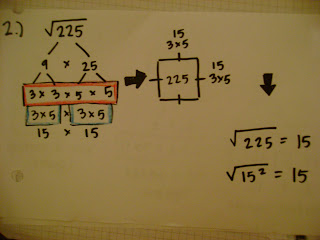
Solution:
  • *The square of a number can be thought as the area of a square.
  • This is one way of finding the factors of 225 because you can also have it 15 x 15.
  • I chose to do 9 x 25.
  • I found the Prime Factors of 9 which was 3 multiplied by itself.
  • For 25, the Prime Factors were 5 multiplied by itself.. (5 x 5=15).
  • I then used a basket after using the Line of Factorization and made the basket so that each basket had an even pair.
  • 3 x 5 = 15, so 15 x 15 = 225!
  • I then showed how it would look like using a square and it's sides.
  • The square root of 225 = 15, which also equals the square root of 15 squared = 15.

- ---------------------------------------------- -


Solution:

A.)
  • I know that to make 144, you can square the number 7 by itself to get your answer.
  • The square of a whole number is a perfect square because if you used 1 block for every unit in the square and had groups of 7 by 7, the length and the area of the square would be the same.
  • I found the Prime Factors of 12 which is 6 and 2. (6 x 2 = 12)
  • Then I found the Prime Factors go 6 and got 3 and 2. (3 x 2)
  • I boxed in the Line of Prime Factorization and then made a basket using those numbers just to get a clearer understanding.
  • This resulted into a perfect square.
B.)
  • Since there is no number that can be multiplied by itself to get 60, I divided 60 to get 30.
  • The Prime Factors of 60 would be 30 and 2.
  • I knew that 3 x 10 would equal 30, and that would be a Prime Factor for that.
  • Finally, I took the number 10 and divided it again to get 5 x 2.
  • The Line of Factorization did not all have even sets of numbers if you would put it in a basket, therefore it is not a perfect square.
D.)
  • Again, I know that there is no square number to make 40, so I just used the prime numbers 5 and 6. (5 x 6= 40)
  • Then I knew that 3 x 2 would make 6.
  • The Line of Factorization would be 5 x 3 x 2, which means you can't basket the numbers evenly.
  • 40 is not a perfect square.

- ------------------------------------------- -

Solution:
  • For 15 a), since I knew that 7 x 7 would equal 49, I used that as my Prime Factor.
  • Notice that 7 x 7 makes a Perfect Square.
  • In the second example I showed how I got the area, which is just side x side.
  • When you prime factor a square you can find either side lengths or square roots.
  • the square root of 49 = 7, which also equals to the square root of 7 squared, which is also 7.

- --------------------------------------------------- -


Solution:
  • For 16 a), I just found the Prime Factor for the number 9 which is 3 and 3.
  • When you multiply 3 by itself, it makes a Perfect Square and equals 9.
  • Next I just showed how it would look like in pictures.
  • You multiply the sides to get your area.
  • The square of a number can be thought as the area of a square, which in this case is 3.
  • The square root of 9 = 3, which can also equal to the square root of 3 squared = 3.

- ------------------------------------------- -


Solution:
  • For this question, I know that there are no square numbers that can equal 54.
  • Note: A square of the number is the number multiplied by itself.
  • For my explanation picture, instead of a square number, I just divided 54 to get 27.
  • 27 x 2 = 57
  • From then on I started looking at it's Prime Factors.
  • Finally, I used the line of factorization.
  • *If you square root the number 57 on the calculator, it will give you an answer of 7.348469228.

- ---------------------------------------------------- -


Solution:
  • For a), what I did was multiply the numbers on the side (9 x 4 = 36) because I know that sxs= area. The answer would be 36m2.
  • For b), I first used my calculator to find out what the square root of 36 was. I got the answer 6, so for that, I know that 6 x 6 makes a perfect square and equals to 36.
  • The boxed numbers are the Line of Prime Factorization.
  • I also used a basket after to help make it more understandable.

- ---------------------------------------- -

Here is a helpful video for a better understanding:


*Sorry if the video is confusing at the end!
Here is a game you might want to play in Mangahigh that is really fun ;)

THANKS FOR GIVING YOUR TIME AND EFFORT INTO READING THIS! Help me out if I have made any mistakes :)

--------------------------------------------------------------------------------------------------------

PYTHAGOREAN RELATIONSHIP


Saturday, January 28, 2012

Samantha's Text Book Scribe Post (4,10,15)

4. Estimate the square root of each number, to one decimal place. Check it with a calculator.

a. 72

b.103

c. 55

10. Kai uses an entire can of paint on a square backdrop for the school play. The label on the can states that one can cover 27 m² of wall surface. Estimate the backdrop's side length, to one decimal place.
5.1m, find the square root of 27m.


15. Order the following numbers from least to greatest: 7, square root of 46, 5.8, square root of 27, and 6.3.
The square root of 46 = 6.7 and the square root of 27 = 5.1.
5.1, 5.8, 6.3, 6.7, 7


Sunday, January 22, 2012

Isabel's Textbook Scribe Post ( 4,7,10) and Phytagorean Relationship

4. Estimate the square root of each number, to one decimal place. Check it with a calculator.


72= The estimated square root that I got for 72 is approximately 8.4 and here's how I got it...


STEPS:

1st step: draw/make a number line

2nd step: find out what are the 2 square root numbers that are close to 72 which are 64 and 81 *how I got 64? 8x8 How I got 81? 9x9*

3rd step: write number 64 on the left side, below it write 8, write number 81 on the right side and below it write 9

4th step: estimate a number that is 8 point something but can't be over 9 so I chose 8.4

5th step: double check your answer with a calculator, when I multiplied 8.4 by 8.4 I got 70.56 which us pretty close to 72 but you can also use 8.5


103= The estimated square root that I got for 103 is approximately 10.1 and here's how I got it...
STEPS:

1st step: draw/make a number line

2nd step: find out what are the 2 square root numbers that are close to 102 which are 100 and 121 *how I got 100? 10x10 How I got 121? 11x11*

3rd step: write number 100 on the left side, below it write 10, write number 121 on the right side and below it write 11

4th step: estimate a number that is 10 point something but can't be over 11 so I chose 10.1

5th step: double check your answer with a calculator, when I multiplied 10.1 by 10.1 I got 102.1 which us pretty close to 102


55= The estimated square root that I got for 55 is approximately 7.3 and here's how I got it...
STEPS:

1st step: draw/make a number line

2nd step: find out what are the 2 square root numbers that are close to 55 which are 49 and 64 *how I got 49? 7x7 How I got 64? 8x8*

3rd step: write number 49 on the left side, below it write 7, write number 64 on the right side and below it write 8

4th step: estimate a number that is 7 point something but can't be over 8 so I chose 7.3

5th step: double check your answer with a calculator, when I multiplied 7.3 by 7.3 I got 53.29 which us pretty close to 55 but you can also use 7.4


7. Identify a whole number with a square root between 11 and 12.

The whole number(s) that I identified between 11 ( 121)and 12 (144) are :


How I got 121? 11x11 and how I got 144? 12x12

MIDDLE NUMBERS ..... between 121 and 144 are

122,123,124,125,126,127,128,129,130,131,13 2,133,134,135,136,137,138,139,140,141,142 and 143 and here's how I got it...


10. Kai uses entire can of paint on a square backdrop for the school play. The label in the can states that one can covers 27 squared meters of wall surface. Estimate the backdrop's side length, to one decimal place.

The estimated backdrop's side length is 5.2 meters and here's how I got it...

1st step: draw/make a number line


2nd step: find out what are the 2 square root numbers that are close to 27 which are 25 and 36 *how I got 25? 5x5 How I got 36? 6x6*

3rd step: write number 25 on the left side, below it write 5 , write number 36 on the right side and below it write 6


4th step: estimate a number that is 5 point something but can't be over 6 so I chose 5.2


http://www.funbrain.com/cgi-bin/ttt.cgi?A1=s&A2=4&A3=0
here's a link that might help you with square roots... Good Luck :)


please do comment if I did something wrong or forgot something :)
*sorry I couldn't post the video*


Phytagorean Relationship


1. Answer in a short paragraph and with diagrams:


Explain the Phytagorean Relationship a2+b2=c2


The Phytagorean Relationship is if you add the 2 legs ( a2 and b2) you'll get the hypotenuse (c2). But in order for you to know that your solution might be correct is when the hypotenuse is the biggest number in all of the 3 important parts. The hypotenuse is the longest because it is diagonal/ slanted.


2. Solve for the missing side length


3. Is this a right triangle? Prove it!


It is NOT a right triangle and here's how I got my answer