Showing posts with label kim873. Show all posts

Sunday, March 11, 2012

Kim's Surface Area Post and Volume Post


Surface Area


Surface Area definition: The total area of the surface of a three-dimensional object.

----------

Rectangular Prism:


Solution:

Top:
( length = 5m ; width = 10m )
a = l x w
a= 5 x 10
a= 50m

Front:
( length = 6m ; width = 10m )
a= l x w
a = 6 x 10
a= 60m

Side:
( length = 6m ; width = 5m )
a= l x w
a = 6 x 5
a= 30m

Total Surface Area Formula:
TSA = 2( T + F + S)
= 2( 50m + 60m + 30m )
= 2( 140m )
= 280m²

----------

Triangular Prism:


Solution:

Rectangles

Rectangle 1:
( length = 9cm ; width = 5cm )
a = l x w
a = 9 x 5
a = 45cm2

Rectangle 2:
( length = 10cm ; width = 5cm )
a = l x w
a = 10 x 5
a= 50cm²

Rectangle 3:
( length = 8cm ; width = 5cm )
a = l x w
a = 8 x 5
a = 40m2

Triangles
( base = 8cm ; height = 9cm )
a = b x h
------
2
a = 8 x 9
------
2
a = 72
------
2
a = 36cm2

TSA = 50cm + 45cm + 40cm + 36cm + 36cm
= 207cm2

----------

Cylinder:


First Way:

Circles:

r = d
---
2
r = 8mm
-----
2
r = 4mm

Circumference:
c = π d
c = 3. 14 x 8
c= 25. 12mm

Lateral Area:
length x width
25.12 x 12
= 301. 44mm2

Area of circle
Area of circle = π r²
= 3.14 x 4²
= 3.14 x 16
= 50.24cm²

TSA = 301.44mm + 50.24mm + 50.24mm
= 401.92mm²

Second Way

l = 12mm ; d = 8mm

r = d
----
2
r = 8mm
------
2
r = 4mm

SA = 2 (3.14 x 42 ) + (3.14 x 8 x 12)
SA = 2 (π r2)+ (π d h)
SA = 2 (50.24) + (301.44)
SA = 401.92 mm2


----------

  • Here is a helpful link for a better understanding of Surface Area.
  • Here is a helpful video for the formula of a Triangular Prism:


Volume:


Triangular Prism:


V = (b x h ÷ 2) x h
V = (3 x 4 ÷ 2) x 8.5
V = 7.5 x 8.5
V = 63.75 m³


Rectangular Prism:

V = l x w x h
V = 20 x 80 x 16
V = 25600 cm³


Triangular Prism with fraction:


V = (b x h ÷ 2) x h
V = (8 x 4 ÷ 2) x 6.5
V = 16 x 6.5
V = 104 cm³


Cylinder:


r = d ÷ 2
r = 12 ÷ 2
r = 6cm

V = π x r
² x h
V = 3.14 x 6² x 15
V = 1695.6 cm³


Tuesday, February 14, 2012

Scribe 1: 2, 8, 15 a, 16 a, 17, 20

Before you go on, please
take the time to read how to work out
square roots and it's meaning.


- ----------------------------------------- -


Solution:
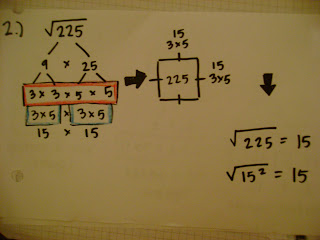
  • *The square of a number can be thought as the area of a square.
  • This is one way of finding the factors of 225 because you can also have it 15 x 15.
  • I chose to do 9 x 25.
  • I found the Prime Factors of 9 which was 3 multiplied by itself.
  • For 25, the Prime Factors were 5 multiplied by itself.. (5 x 5=15).
  • I then used a basket after using the Line of Factorization and made the basket so that each basket had an even pair.
  • 3 x 5 = 15, so 15 x 15 = 225!
  • I then showed how it would look like using a square and it's sides.
  • The square root of 225 = 15, which also equals the square root of 15 squared = 15.

- ---------------------------------------------- -


Solution:

A.)
  • I know that to make 144, you can square the number 7 by itself to get your answer.
  • The square of a whole number is a perfect square because if you used 1 block for every unit in the square and had groups of 7 by 7, the length and the area of the square would be the same.
  • I found the Prime Factors of 12 which is 6 and 2. (6 x 2 = 12)
  • Then I found the Prime Factors go 6 and got 3 and 2. (3 x 2)
  • I boxed in the Line of Prime Factorization and then made a basket using those numbers just to get a clearer understanding.
  • This resulted into a perfect square.
B.)
  • Since there is no number that can be multiplied by itself to get 60, I divided 60 to get 30.
  • The Prime Factors of 60 would be 30 and 2.
  • I knew that 3 x 10 would equal 30, and that would be a Prime Factor for that.
  • Finally, I took the number 10 and divided it again to get 5 x 2.
  • The Line of Factorization did not all have even sets of numbers if you would put it in a basket, therefore it is not a perfect square.
D.)
  • Again, I know that there is no square number to make 40, so I just used the prime numbers 5 and 6. (5 x 6= 40)
  • Then I knew that 3 x 2 would make 6.
  • The Line of Factorization would be 5 x 3 x 2, which means you can't basket the numbers evenly.
  • 40 is not a perfect square.

- ------------------------------------------- -

Solution:
  • For 15 a), since I knew that 7 x 7 would equal 49, I used that as my Prime Factor.
  • Notice that 7 x 7 makes a Perfect Square.
  • In the second example I showed how I got the area, which is just side x side.
  • When you prime factor a square you can find either side lengths or square roots.
  • the square root of 49 = 7, which also equals to the square root of 7 squared, which is also 7.

- --------------------------------------------------- -


Solution:
  • For 16 a), I just found the Prime Factor for the number 9 which is 3 and 3.
  • When you multiply 3 by itself, it makes a Perfect Square and equals 9.
  • Next I just showed how it would look like in pictures.
  • You multiply the sides to get your area.
  • The square of a number can be thought as the area of a square, which in this case is 3.
  • The square root of 9 = 3, which can also equal to the square root of 3 squared = 3.

- ------------------------------------------- -


Solution:
  • For this question, I know that there are no square numbers that can equal 54.
  • Note: A square of the number is the number multiplied by itself.
  • For my explanation picture, instead of a square number, I just divided 54 to get 27.
  • 27 x 2 = 57
  • From then on I started looking at it's Prime Factors.
  • Finally, I used the line of factorization.
  • *If you square root the number 57 on the calculator, it will give you an answer of 7.348469228.

- ---------------------------------------------------- -


Solution:
  • For a), what I did was multiply the numbers on the side (9 x 4 = 36) because I know that sxs= area. The answer would be 36m2.
  • For b), I first used my calculator to find out what the square root of 36 was. I got the answer 6, so for that, I know that 6 x 6 makes a perfect square and equals to 36.
  • The boxed numbers are the Line of Prime Factorization.
  • I also used a basket after to help make it more understandable.

- ---------------------------------------- -

Here is a helpful video for a better understanding:


*Sorry if the video is confusing at the end!
Here is a game you might want to play in Mangahigh that is really fun ;)

THANKS FOR GIVING YOUR TIME AND EFFORT INTO READING THIS! Help me out if I have made any mistakes :)

--------------------------------------------------------------------------------------------------------

PYTHAGOREAN RELATIONSHIP


Monday, November 28, 2011

Kim's Scribe Post (Show you Know)

Show You Know:
Determine the percent of each number:


Part 1:


160% of $53.27= 85.22
1) I first took the number 100 because I know that if I have 100, 50, and 10, and 1 percent, I can solve any problem. I chose 100 because it seemed to be the easier number to start off with. I then divided the number into 2 (100÷2) to make 50. Together that makes 150, so I need that 10% more. From the 100, I divided it into 10 (100÷10) and that makes 10! On the money part, I calculated using the same method from the percent side and if you add them together, you get your answer. 160% = $85.22.

The second picture just shows a way I do it, if that's easier for you.


----------


3/4% of 135=
2) From the picture underneath the first one, I had to convert the fraction to make it into a decimal, and then a percentage to make it easier. That would make 3/4 turn into 75%. So for the first picture I just showed how 100 could make 75% by dividing 100 by two to make 50, and then dividing it again to make 25. I did this because 50+25= 75. The calculation would by 75%=101.25.


----------


55 8/10% of 500=
3) For the first picture, I divided 100 by two to make 50. From the 100, I also divided by 10 to make 10. From the 10, i divided by 2 and 10 to make 5 and 0.1. I then multiplied 0.1 (0.1 x 8 = 4) because if you didn't multiply, you would just have 55. I did this so I could find out the numbers to get to 55.8 percent. For the numbers side, all I did was use the same method on the other side to get my answer of 249. So overall, my answer would be 55.8 = 279.

The second picture shows a way kind of like the picture on top of it, but just how I do it. All I do is find out the numbers you usually use (100, 50, 25, 10, 1 percent) and then use the numbers you get to get your answer. The second picture shows how I converted first to get a clearer understanding, and then calculating my answer using mental math.


----------
Part 2:


350% of $10=
4) The top picture shows a T-Chart in which I took the percent (100%) and from that number, I found out what 300 percent was. I just had to multiply 100 x 3 which equals 300. The last step was pretty simple. You just had to divide 100 by 2 to get 50. Again, you use the same method you used on the percent part, and use the method for the money part. In other words, I think you could say that you just had to divide 350 by 10 to get $35. 350% of 10= $35.


----------


0.1% of 5 000=
5) The first picture shows that you have to divide. What I did was find out what 100÷100 and that equaled 1. To find 0.1%, you have to divide 1÷10 and that would equal 0.1%. On the number side, you had to divide 5 000 by 100 to get 50, then divide 10 to get 5. 1% of 5 000= 5.

The second picture is the same thing, but instead of dividing, I multiplied.


----------


2 1/10% of $20 000=
6) Finally for the last question, on the first picture it was basically the same thing as the second picture, except it isn't in T-Chart form.

On the second picture, I just had to start off with 100% and use another 100% to get 200%. I then just divided by 10 to get $2 000 and added the numbers all up! I used the same method for the money side.


----------

*I couldn't find a video... sorry... But I did find a video on another way you could find the percent of a number, just not in the way we do it.


Game links:


VISIT THIS WEBSITE FOR MORE VIDEOS ON THE OTHER WAY YOU CAN SOLVE IT! :)
http://www.onlinemathlearning.com/percent-of-number.html

*If I made any mistakes, please let me know!

Wednesday, November 23, 2011

We Day 2011

I remember waking up on November 23rd really early because of the rush of excitement towards an event called "We Day" today. We Day is not only a one day event, it's a chain to making differences everyday to making our community, environment, and the world a better place. It is when not only the 16,000 of those who came to attend the We Day concert help, but for everyone to stand and strive to take action. It is the movement of our time, and a movement where young people like me can lead to global change. Among those 16,000 young kids like me, our school only had to pick 30 students to go, and that included me. These 30 kids are not only responsible for being leaders today, but also to become difference makers tomorrow, and in the future. With the help of speakers like Mia Farrow, Paul Martin, Al Gore, Rick Hanson, Winnipeg's own Hannah Taylor, Michel Chickwanine, Dennis Whiteburg, Sharon Conway, Spencer West, and Craig and Marc Keilburger, we realized several lessons. I think the biggest lesson we were faced to accept was that there is no I won't, I can't, or never, but there is only a "we can" and "we are". We are the children for this future's generation that could stop world poverty, death, lack of education, clean water, global warming, human rights, and many more. One speaker that came was a man named Rick Hanson. Rick Hanson remembered from Mohatma Gandhi that when you pray, use your feet. I think that means when you pray, also remember that change starts with you, and nothing can happen if you don't step up and try. Rick Hanson is also known for being the "Man in Motion" for not only becoming the winner of 19 international wheelchair marathons or because he was a paralympian, but because he wheeled around the world across 35 countries in 1985 for creating opportunities for those with spinal cord injuries since that was the cause of him on the wheelchair when he was just 15 years old. His message to us was that anything is possible. Another speaker that captured my attention was Michel Chickwanine. We all had to be silent for all the children who can't stand up for themselves because of things like exploitation, poverty and the denial of their basic rights. This event is called "The Vow of Silence", when on November 30th, for 24 hours we all have to be silent, and we can't talk. We can't even use twitter, Facebook, text messaging, email, or any other sort of contact towards people. This event is for the children who are denied to speak, and denied their voice. Michel instead of talking, used big cards to tell us his story. He grew up in the Democratic Republic of Congo during the Great War of Africa. He faced many problems I can't even handle at a young age like the torture of his father who had only wanted a right to political beliefs, and the rape of his mother. Michel was forced to leave his home as a refugee at only 11 years old. He became a child soldier and was forced to do things he could not refuse. He was even forced to kill his best friend Kevin. One day he was out in the soccer field when he was blindfolded and his wrists were cut with the filling of cocaine and drug powder. When the people who kidnapped him told him to shoot, he found out he shot his best friend, and from then on until he escaped to Kenya, the other child solderers had become his family. Michel is now a motivational speaker un University teaching kids about the lives of child soldiers and teaching us about the Vow of Silence. The Vow of Silence is when we show our solidarity by not speaking for 24 hours for those who cannot speak for themselves because of poverty, exploitation, and disease. When Spencer West came up to the stage, I couldn't help but look up to him. Here he is, talking about all the differences we could make and how he lost both his legs at the age of 5, he used his humour and smiled the whole time. That to me was so beautiful because throughout all the people who thought negative about him and told him he couldn't make a difference, he did. He traveled to Kenya to build a school and he understood that 6 billion people around the world have a different story, and he was amazed about all the different stories in Africa that involved starvation and poverty. One day while he was talking to young children, a young girl raised her hand and told him she didn't know these sorts of things happened to white people too. Because of this, this motivated him to stand and teach people from all around the world that you CAN make a change. That you CAN make a difference. That you CAN start with one hand, and lead to all hands reuniting and taking action. Of course the entertainment in the arena that the band and singers performed were very fun and got us standing up on our feet, but Craig and Marc Keilburger wrapped it up with a message that all speakers had believed, and that was that our generation is hope to a bright future. Our generation could save one less life, and not only become the change we see in the world, but the change that we are. This whole experience made me open my eyes wide, and see things differently. I have come to realize that everyone has a different story and life is too short for us not to make a change. Before I pass away, I want to step out of the world not only feeling good making difference, but because after everything I have possibly done, I would die saving someone. This whole experience changed in and out of me, and I will never forget about this. I will forever remember and continue the chain. Because I will make a difference.