Before you go on, please
take the time to read how to work out
square roots and it's meaning.

- ----------------------------------------- -

Solution:
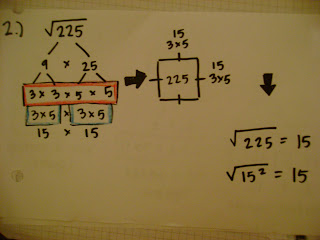
- *The square of a number can be thought as the area of a square.
- This is one way of finding the factors of 225 because you can also have it 15 x 15.
- I chose to do 9 x 25.
- I found the Prime Factors of 9 which was 3 multiplied by itself.
- For 25, the Prime Factors were 5 multiplied by itself.. (5 x 5=15).
- I then used a basket after using the Line of Factorization and made the basket so that each basket had an even pair.
- 3 x 5 = 15, so 15 x 15 = 225!
- I then showed how it would look like using a square and it's sides.
- The square root of 225 = 15, which also equals the square root of 15 squared = 15.
- ---------------------------------------------- -

 Solution:
A.)
- I know that to make 144, you can square the number 7 by itself to get your answer.
- The square of a whole number is a perfect square because if you used 1 block for every unit in the square and had groups of 7 by 7, the length and the area of the square would be the same.
- I found the Prime Factors of 12 which is 6 and 2. (6 x 2 = 12)
- Then I found the Prime Factors go 6 and got 3 and 2. (3 x 2)
- I boxed in the Line of Prime Factorization and then made a basket using those numbers just to get a clearer understanding.
- This resulted into a perfect square.
B.)
- Since there is no number that can be multiplied by itself to get 60, I divided 60 to get 30.
- The Prime Factors of 60 would be 30 and 2.
- I knew that 3 x 10 would equal 30, and that would be a Prime Factor for that.
- Finally, I took the number 10 and divided it again to get 5 x 2.
- The Line of Factorization did not all have even sets of numbers if you would put it in a basket, therefore it is not a perfect square.
D.)
- Again, I know that there is no square number to make 40, so I just used the prime numbers 5 and 6. (5 x 6= 40)
- Then I knew that 3 x 2 would make 6.
- The Line of Factorization would be 5 x 3 x 2, which means you can't basket the numbers evenly.
- 40 is not a perfect square.
- ------------------------------------------- -

 Solution:
- For 15 a), since I knew that 7 x 7 would equal 49, I used that as my Prime Factor.
- Notice that 7 x 7 makes a Perfect Square.
- In the second example I showed how I got the area, which is just side x side.
- When you prime factor a square you can find either side lengths or square roots.
- the square root of 49 = 7, which also equals to the square root of 7 squared, which is also 7.
- --------------------------------------------------- -

 Solution:
- For 16 a), I just found the Prime Factor for the number 9 which is 3 and 3.
- When you multiply 3 by itself, it makes a Perfect Square and equals 9.
- Next I just showed how it would look like in pictures.
- You multiply the sides to get your area.
- The square of a number can be thought as the area of a square, which in this case is 3.
- The square root of 9 = 3, which can also equal to the square root of 3 squared = 3.
- ------------------------------------------- -

Solution:
- For this question, I know that there are no square numbers that can equal 54.
- Note: A square of the number is the number multiplied by itself.
- For my explanation picture, instead of a square number, I just divided 54 to get 27.
- 27 x 2 = 57
- From then on I started looking at it's Prime Factors.
- Finally, I used the line of factorization.
- *If you square root the number 57 on the calculator, it will give you an answer of 7.348469228.
- ---------------------------------------------------- -
 Solution:
- For a), what I did was multiply the numbers on the side (9 x 4 = 36) because I know that sxs= area. The answer would be 36m2.
- For b), I first used my calculator to find out what the square root of 36 was. I got the answer 6, so for that, I know that 6 x 6 makes a perfect square and equals to 36.
- The boxed numbers are the Line of Prime Factorization.
- I also used a basket after to help make it more understandable.
- ---------------------------------------- -
Here is a helpful video for a better understanding:
*Sorry if the video is confusing at the end!
Here is a
game you might want to play in Mangahigh that is really fun ;)
THANKS FOR GIVING YOUR TIME AND EFFORT INTO READING THIS! Help me out if I have made any mistakes :)
--------------------------------------------------------------------------------------------------------
PYTHAGOREAN RELATIONSHIP

 Is This A Right Triangle? Prove It!


